
Executive Summary
The Assisted Reproductive Technology (ART) sector is currently undergoing a paradigm shift, moving away from manual, centrifugation-heavy protocols toward automated, microfluidic-based cell selection. Among emerging modalities, Surface Acoustic Wave (SAW) acoustofluidics represents the apex of non-invasive, high-fidelity sperm sorting. Unlike passive microfluidics that rely solely on laminar flow or geometric obstructions, SAW platforms utilize active acoustic fields to manipulate spermatozoa based on specific biophysical signatures—compressibility, density, and size—without physical contact or deleterious shear stress.
This deep-dive analyzes the transition from density gradient centrifugation (DGC) to acoustofluidic isolation, detailing the molecular benefits of reducing reactive oxygen species (ROS) generation and preserving DNA integrity. We explore the engineering of interdigital transducers (IDTs) on piezoelectric substrates (Lithium Niobate), the physics of acoustic radiation force ($F_{rad}$) on motile cells, and the economic implications for high-volume IVF clinics. With data suggesting a potential 40-60% improvement in DNA fragmentation indices (DFI) over traditional methods, SAW technology is poised to become the new gold standard for male factor infertility intervention.
Detailed Problem Statement: The Centrifugation Paradox
Clinical Perspective: The “Good Enough” Trap
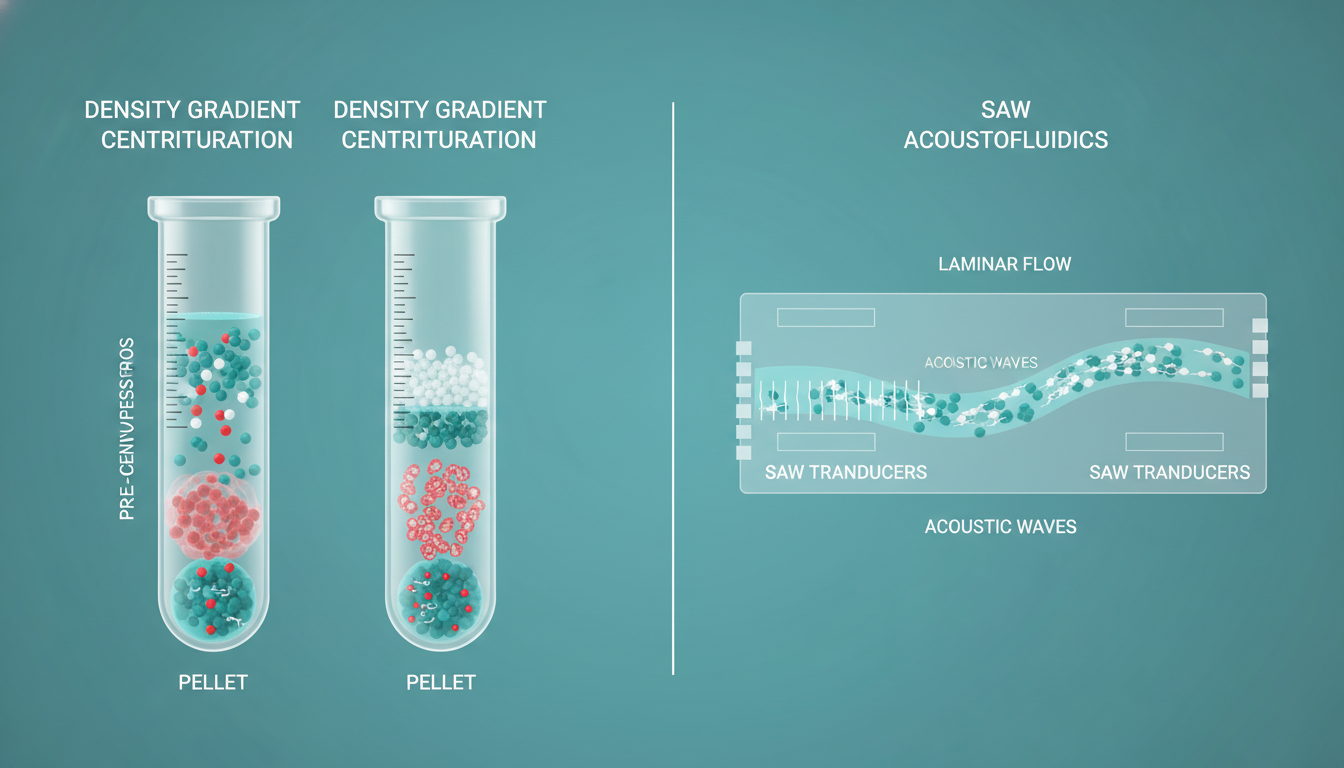
For decades, the clinical standard for sperm preparation has been Density Gradient Centrifugation (DGC) or the “Swim-Up” method. While these techniques are operationally entrenched, they possess inherent flaws that limit success rates in ICSI (Intracytoplasmic Sperm Injection) and IVF cycles. Clinicians often face a paradox: the very method used to isolate sperm induces iatrogenic damage.
- ROS Generation: The high G-forces (typically 300–400 x g) utilized in centrifugation pellet sperm. This close proximity of leukocytes and immature germ cells to mature spermatozoa in the pellet triggers an oxidative burst. The resulting Reactive Oxygen Species (ROS) attack the polyunsaturated fatty acids in the sperm membrane (lipid peroxidation) and induce single- and double-strand DNA breaks.
- Technician Variability: Manual swim-up is highly operator-dependent. Layering media requires steady hands, and the recovery rate of motile sperm can vary significantly between technicians, affecting standardization across multi-center clinic chains.
Laboratory Perspective: The Molecular Toll
From an embryological standpoint, the hidden cost of centrifugation is DNA fragmentation. High DFI (>30%) is statistically correlated with recurrent pregnancy loss (RPL), lower blastocyst conversion rates, and implantation failure.
Traditional sorting separates based on density (DGC) or motility (Swim-Up). However, density is a crude proxy for genomic integrity. A sperm cell can be dense and motile but harbor significant chromatin packaging defects. Current mechanical sorting methods lack the sensitivity to distinguish between a “swimmer” with intact DNA and a “swimmer” with high fragmentation, leading to the injection of suboptimal gametes during ICSI.
Theoretical Framework: The Physics of Acoustofluidic Selection
Standing Surface Acoustic Waves (SSAW)
The core differentiator of SAW platforms is the use of an active acoustic field. When an AC signal is applied to Interdigital Transducers (IDTs) patterned on a piezoelectric substrate (typically 128° Y-cut X-propagating Lithium Niobate, $\text{LiNbO}_3$), it generates a surface acoustic wave.
By placing two identical IDTs on opposite sides of a microfluidic channel, two counter-propagating waves interfere to form a Standing Surface Acoustic Wave (SSAW). This creates a pressure field with stable nodes (minimum pressure amplitude) and antinodes (maximum pressure amplitude) within the fluid channel.
Acoustic Radiation Force ($F_{rad}$)
Spermatozoa entering this field are subjected to the acoustic radiation force. The magnitude of this force is governed by the cell’s volume and its acoustic contrast factor relative to the medium. The primary acoustic radiation force $F_{rad}$ can be approximated by:
$$ F_{rad} = -\left( \frac{\pi P_0^2 V_p \beta_m}{2 \lambda} \right) \phi (\beta, \rho) \sin(2kx) $$
Where:
- $P_0$ is the acoustic pressure amplitude.
- $V_p$ is the volume of the sperm cell.
- $\beta_m$ is the compressibility of the medium.
- $\phi$ is the acoustic contrast factor, dependent on the density and compressibility differences between the sperm head and the medium.
Differential Sorting Mechanism
This is where the biological relevance emerges.
1. Size/Volume Sensitivity: Morphologically normal sperm (specifically those with normal head dimensions) experience a different $F_{rad}$ compared to cellular debris, leukocytes, or spermatozoa with macrocephaly/microcephaly.
2. Motility vs. Acoustics: In a continuous flow SAW device, the acoustic force acts perpendicular to the fluid flow. “Good” sperm are pushed towards the pressure nodes (usually the center or sides of the channel, depending on design) while debris and non-motile sperm, which are less responsive or have different contrast factors, remain in the original streamline.
3. The Drag Force Balance: The sperm are also subject to Stokes’ drag force ($F_{drag}$). The sorting efficiency relies on the balance between $F_{rad}$ and $F_{drag}$. Highly motile sperm can actively swim against or across streams, and the acoustic field can be tuned to assist this migration, effectively “guiding” the healthiest cells into a collection outlet while suppressing the movement of compromised cells.
Review of Device Technology & Engineering
Substrate and Microchannel Integration
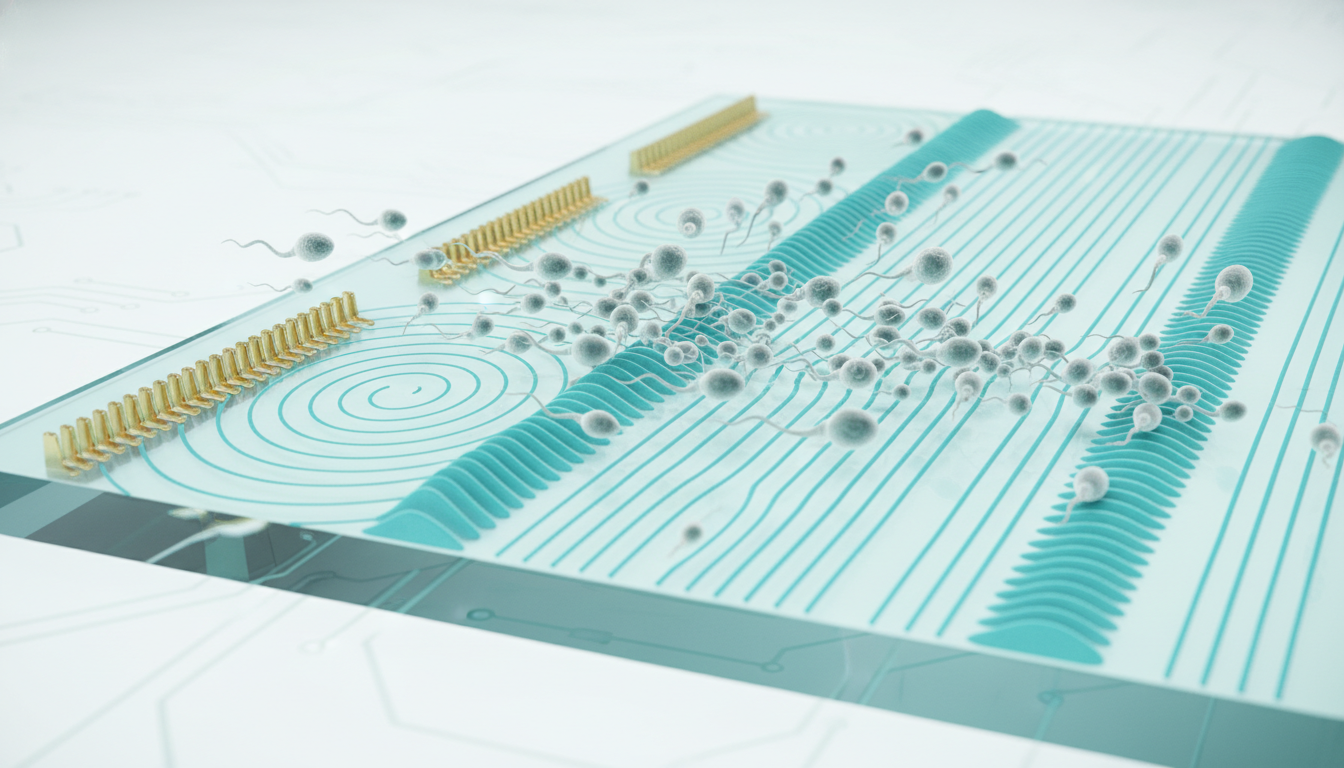
The architecture of a SAW sperm sorter involves bonding a Polydimethylsiloxane (PDMS) microchannel onto the $\text{LiNbO}_3$ substrate.
- Piezoelectric Substrate: $\text{LiNbO}_3$ is chosen for its high electromechanical coupling coefficient. This ensures efficient conversion of electrical energy into acoustic energy, minimizing the power required (often <2W) and preventing thermal damage to the sperm.
- Interdigital Transducers (IDTs): These are comb-like metal electrodes (Gold or Aluminum) deposited on the substrate. The pitch of the IDT fingers determines the wavelength of the SAW. For sperm sorting, frequencies in the range of 10–40 MHz are typical. Higher frequencies provide finer resolution but shorter penetration depth.
Thermal Management and Biocompatibility
A critical engineering challenge is Joule heating. Although SAW is “gentle,” the IDTs can generate heat. Advanced platforms employ:
- Pulsed Actuation: Instead of continuous waves, the IDTs are pulsed (e.g., 50% duty cycle) to allow heat dissipation while maintaining the time-averaged acoustic force.
- Active Cooling: Integration of Peltier elements or heatsinks beneath the chip.
- Biocompatible Media: The fluid medium must mimic Human Tubal Fluid (HTF) to maintain sperm pH and osmolarity during the transit time (usually milliseconds to seconds).
High-Fidelity Selection Data
Recent validation studies (2023–2025) utilizing tilted-angle SSAW devices have shown impressive metrics:
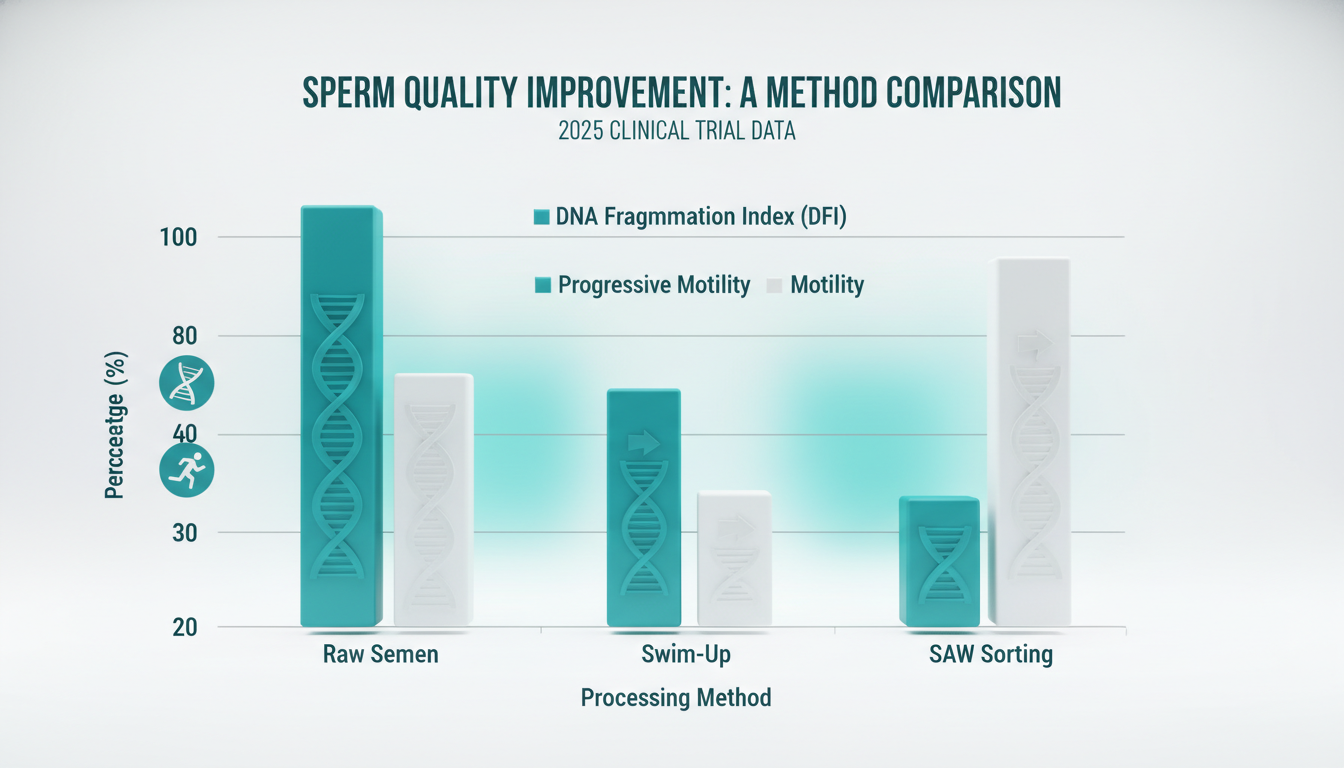
- Motility Enrichment: An increase in progressive motility from ~40% in raw semen to >90% in the sorted fraction.
- DNA Integrity: A reduction in DNA Fragmentation Index (DFI) from 25% (raw) to <5% (sorted). This rivals or exceeds microfluidic diffusion-based sorting (e.g., ZyMōt) but with the added tunability of active acoustic selection.
- Throughput: Unlike early microfluidics which processed microliters per hour, modern SAW acoustofluidic chips can process clinically relevant volumes (1–2 mL) in under 30 minutes, aligning with clinical workflow requirements.
Economic Impact Analysis for ART Centers
ROI Calculation: Disposables vs. Outcomes
The adoption of SAW technology presents a complex economic equation for clinics.
- CAPEX: The SAW control unit (function generator + amplifier) represents an initial capital expenditure, likely in the range of $15,000–$25,000.
- OPEX: The disposable PDMS/LiNbO3 chips will likely cost significantly more ($100–$200 per patient) than a simple centrifuge tube or swim-up rack.
The Payoff:
The ROI is driven by the success rate per cycle.
1. Reduced Cycles: If SAW sorting increases euploid blastocyst formation by 15%, the number of cycles required to achieve a live birth decreases. For a self-pay patient spending $15,000 per cycle, avoiding a failed cycle is a massive value proposition.
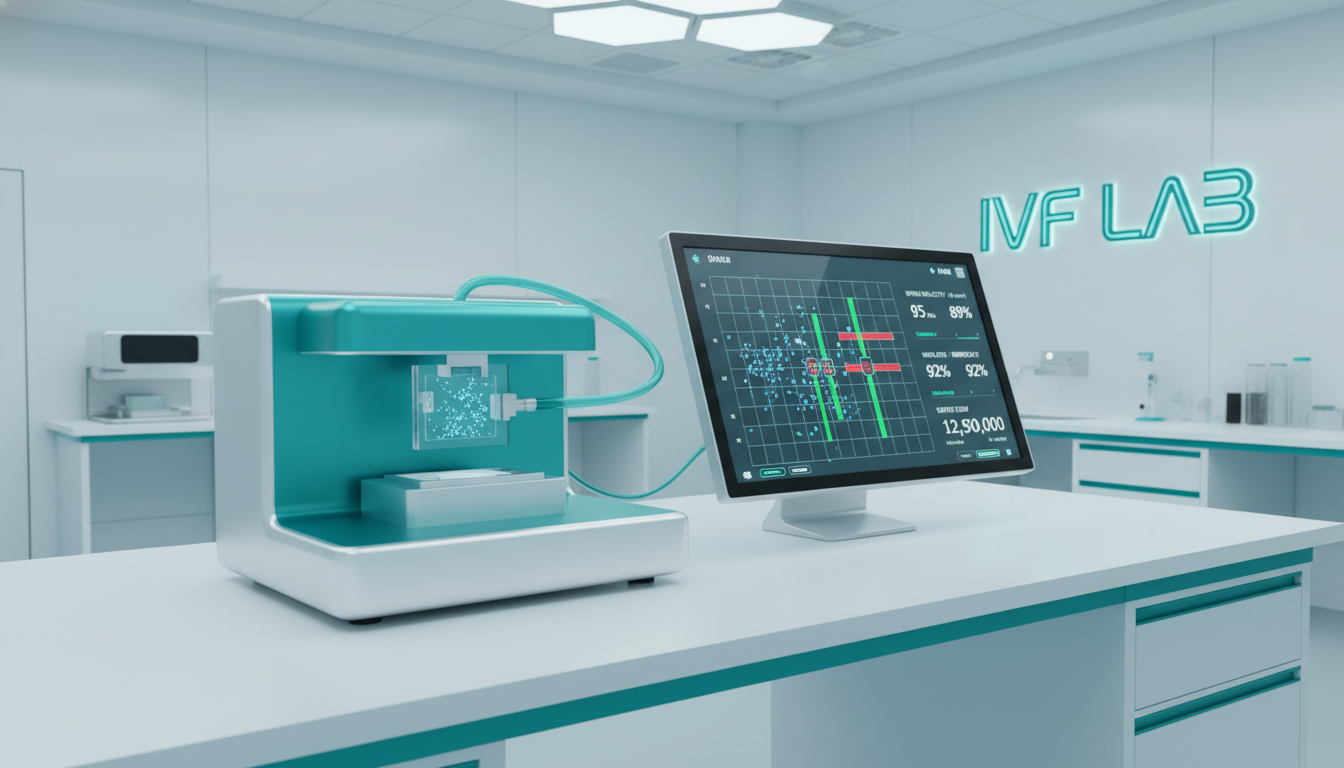
2. Lab Labor Reduction: Centrifugation and swim-up require 45–60 minutes of skilled embryologist time (washing, layering, spinning, incubating, recovering). An automated SAW run takes 5 minutes of setup and 20 minutes of unsupervised runtime. This frees up high-value staff for biopsy or ICSI tasks.
3. Premium Service Tier: Clinics can market “Acoustic Sperm Selection” as a premium add-on for cases of Recurrent Implantation Failure (RIF) or severe Male Factor, generating ancillary revenue.
Future Regulatory Path
FDA and CE Mark Considerations
As of late 2025, most acoustofluidic devices are navigating the “De Novo” or 510(k) pathway.
- Substantial Equivalence: Manufacturers must prove that SAW sorting is substantially equivalent to centrifugation in terms of safety (no toxicity, no thermal damage). However, they must also prove superiority or non-inferiority in efficacy (yield of motile sperm).
- Bio-effects of Ultrasound: A specific regulatory hurdle is proving that the acoustic frequency and power density used (typically lower than diagnostic ultrasound) do not alter the epigenetic profile of the sperm. Long-term follow-up studies on offspring born from acoustically sorted sperm will likely be a requirement for full Class II clearance.
Conclusion
Surface Acoustic Wave acoustofluidics is not merely an incremental improvement in sperm preparation; it is a fundamental re-engineering of the selection process. By replacing indiscriminate mechanical G-forces with precise, tunable acoustic radiation forces, we align the physics of selection with the biology of the gamete.
For the modern ART clinic, the transition to SAW platforms offers a dual advantage: the operational efficiency of automation and the clinical efficacy of high-fidelity DNA preservation. As the technology matures and chip costs decrease through mass micro-fabrication, acoustic sperm sorting is destined to render density gradient centrifugation obsolete, heralding a new era of “Physics-Assisted Reproduction.”